Product Description
Product overview:
Servo hydraulic cylinder is the hydraulic actuator in the electro – hydraulic servo system.As the servo hydraulic cylinder is a key link in the closed loop of the electro-hydraulic servo system, its performance index directly affects the precision and the dynamic and static quality of the system.
Servo hydraulic cylinder and common hydraulic cylinder, cylinder and cylinder head, piston and piston rod, sealing device, buffer device and exhaust device 5 parts.
Servo cylinder is the servo motor and screw integrated design of modular products, the servo motor rotation into linear motion, at the same time the servo motor zui good advantages – accurate speed control, accurate revolution control, accurate torque control into – accurate speed control, accurate position control, accurate thrust control;High precision linear motion series of new revolutionary products.
Product advantages:
The servo hydraulic cylinder manufactured by HangZhou xinlaifu hydraulic pneumatic equipment co., ltd. has the following advantages:
1. Low friction, no crawling, high frequency response;Low internal leakage, low external leakage;Its friction pair is usually treated specially.
2. Steel cylinder: hard chrome plated polishing or fine grinding of internal friction surface.
3. Piston seal: o-ring made of polyethylene filled with glass beads.
4. Piston rod seal: pre-added lip seal ring made of butadiene rubber, also with a small cone inside the guide sleeve static and dynamic pressure seal ring.
Piston rod guide sleeve: FE3N cast iron with high wear resistance and hardness.
6. Dust ring: bimetal type, and pre-ground into a cutting edge type.
7. Oil pipe: the oil pipe between the servo valve and the hydraulic cylinder passes through the channel directly drilled in the ferry block and preinstalled thick wall rigid short pipe (accessories).
The servo hydraulic cylinder manufactured by us is mainly reflected in the following aspects:
1. Hydrostatic bearing seal
The hydrostatic bearing is provided with a hydrostatic piston rod guide device, and the rod guide device and the seal are in 1 component.The piston rod floats on an oil film and can withstand large transverse shear forces.The pressure supply of the static bearing is realized through the internal structure of the cylinder, which can bear a large lateral force. Because the sealing and dustproof ring with contact do not bear the pressure, the residual friction within the whole pressure range is very small, thus ensuring the high dynamic and high life characteristics of the servo hydraulic cylinder.
2. Ring gap seal
Ring gap seal is a non-contact seal, due to the difference in pressure, so that the oil through the smaller orifice to form a very thin oil film, so as to replace the ordinary seal to achieve the sealing effect, but its zui large lateral force is limited.There is no pressure on the contact seal and dustproof ring, the piston rod is guided by the guide element optimized for friction, so the starting friction within the whole pressure range is very small, thus ensuring the servo hydraulic cylinder’s high dynamic and high life characteristics.
- The difference between ordinary hydraulic cylinder and servo hydraulic cylinder
- Common hydraulic cylinder servo hydraulic cylinder
- The cylinder should meet the requirement of strength, stiffness and strength
- The force end of the piston rod should meet the requirement of stiffness and there is no instability problem
- The effect of fixed stiffness on stability should be calculated when the fixed method meets the requirements of strength and action
- The output of the cylinder should satisfy the dynamic index of the system under static load and dynamic load
- Cylinder seal is to prevent oil leakage and leakage to prevent internal leakage and leakage, the sealing ring dynamic, static friction coefficient is close, and the friction coefficient as small as possible.If the requirements of repeated speed, sometimes need a certain amount of internal leakage.
- The running speed of the cylinder is controlled by the electrical signal, so it is unnecessary to consider the buffering device.
- The position of the sensor on the drive cylinder may prevent the travel switch from being considered
- The closer the distance between the pump station and the valve stand from the actuator servo valve and the hydraulic cylinder, the better
- Few disassembly facilitate tear open outfit, convenient check servo valve and the sensor
Servo cylinder features:
closed-loop servo control, control accuracy up to 0.01mm;Fine control thrust, increase pressure sensor, control precision up to 1%;
It is easy to connect with PLC and other control systems to achieve high precision motion control.Low noise, energy saving, clean, high rigidity, impact resistance, long life, simple operation and maintenance.
The servo cylinder can be trouble-free in harsh environment, and the protection level can reach IP66.Long-term work, and achieve high intensity, high speed, high precision positioning, smooth movement, low noise.
So it can be widely used in paper industry, chemical industry, automobile industry, electronic industry, mechanical automation industry, welding industry and so on.
Low cost maintenance: the servo cylinder only needs regular grease injection and lubrication when working in complex environment, and no vulnerable parts need maintenance and replacement, which will reduce a lot of after-sales service costs compared with the hydraulic system and pneumatic system.
Hydraulic cylinder and cylinder zui good alternative: servo cylinder can completely replace the hydraulic cylinder and cylinder, and realize the advantages of more environmental protection, more energy saving, cleaner, easy to connect with PLC and other control systems, to achieve high precision motion control.
Configuration flexibility: can provide very flexible installation configuration, full series of installation components: installation flange, back flange, side flange, rear hinged, lug shaft installation, guide module;It can be installed directly with the servo motor or in parallel;Various accessories can be added: limit switch, planetary reducer, pretightening nut, etc.Drive can choose ac brake motor, dc motor, stepper motor, servo motor.
Application field
1. Entertainment industry: robot arms and joints, dynamic seats, etc
2. Military industry: simulation aircraft, simulation and simulation, etc
3. Automobile industry: press machine, test instrument, etc
4. Industrial industry: food machinery, ceramic machinery, welding machinery, lifting platform, etc
| Quantity(Acres) | 1 – 10 | >10 |
| Est. Time(days) | 3 | To be negotiated |
Customer Service
1. You may email us through the Alibaba messaging system if you have a question
or would like to submit a comment.
2. Generally, email will be responded to within 24 hours; except on every Sunday
and holidays. We will reply as soon as we back in office.
2. We will send you tracking information to the e-mail address you have registered with Alibaba.
3. If you don’t see what you are looking for, just send us an e-mail with picture/picture
and we will be glad to help you.
4. Positive feedback is very important to us.
Packaging & Shipping
Delivery Details
Delivery time depends on the destination and other factors, it may up to 7 work days.
In order to ensure you receive you order tax free CHINAMFG import, we will declare it as a “Sample”with a lower value.This lower price does not reflect the total price you paid.
After we ship the goods, we will email you the shipping information, as well as tracking number.
FAQ
Questions you maybe inquiry
Q1:Could you custom products?
We can manufacture it according to your drawings or samples.
Q2: I want to buy your products, how can I pay?
A :You can pay via T/T , WEST UNION or other payment terms we reach agreement.
Q3: How can you guarantee the quality?
A: One year’s warranty against B/L date.
If You meet with quality problem, we promise to responsible for it.
Q4: If we don’t find what we want on your website, what should we do?
A: You can email us the descriptions and pictures of the products you need, We will check whether we can make it.
Q5: Can we buy 1 pc of each item for quality testing?
A: Yes, we understand quality test is important and we are glad to send 1pc for quality testing.
Q6: What is the lead time?
A: For this product, normally 3 days,3 days and lead time is calculated from the day we receive your deposit.
Exact time is determined by factory schedule.
Our customer say:
| Material: | Steel |
|---|---|
| Usage: | Print, Semiconductor, Automation and Control, Robot |
| Structure: | Piston Cylinder |
| Power: | Hydraulic |
| Standard: | Standard, Nonstandard |
| Pressure Direction: | Double-acting Cylinder |
| Customization: |
Available
|
|
|---|
Can hydraulic cylinders be integrated with modern telematics and remote monitoring?
Yes, hydraulic cylinders can indeed be integrated with modern telematics and remote monitoring systems. The integration of hydraulic cylinders with telematics and remote monitoring technology offers numerous benefits, including enhanced operational efficiency, improved maintenance practices, and increased overall productivity. Here’s a detailed explanation of how hydraulic cylinders can be integrated with modern telematics and remote monitoring:
1. Sensor Integration:
– Hydraulic cylinders can be equipped with various sensors to gather real-time data about their performance and operating conditions. Sensors such as pressure transducers, temperature sensors, position sensors, and load sensors can be integrated directly into the cylinder or its associated components. These sensors provide valuable information about parameters such as pressure, temperature, position, and load, enabling remote monitoring and analysis of the cylinder’s behavior.
2. Data Transmission:
– The data collected from the sensors in hydraulic cylinders can be transmitted wirelessly or through wired connections to a central monitoring system. Wireless communication technologies such as Bluetooth, Wi-Fi, or cellular networks can be employed to transmit data in real-time. Alternatively, wired connections such as Ethernet or CAN bus can be utilized for data transmission. The choice of communication method depends on the specific requirements of the application and the available infrastructure.
3. Remote Monitoring Systems:
– Remote monitoring systems receive and process the data transmitted from hydraulic cylinders. These systems can be cloud-based or hosted on local servers, depending on the implementation. Remote monitoring systems collect and analyze the data to provide insights into the cylinder’s performance, health, and usage patterns. Operators and maintenance personnel can access the monitoring system through web-based interfaces or dedicated software applications to view real-time data, receive alerts, and generate reports.
4. Condition Monitoring and Predictive Maintenance:
– Integration with telematics and remote monitoring enables condition monitoring and predictive maintenance of hydraulic cylinders. By analyzing the collected data, patterns and trends can be identified, allowing for the detection of potential issues or anomalies before they escalate into major problems. Predictive maintenance algorithms can be applied to the data to generate maintenance schedules, recommend component replacements, and optimize maintenance activities. This proactive approach helps prevent unexpected downtime, reduces maintenance costs, and maximizes the lifespan of hydraulic cylinders.
5. Performance Optimization:
– The data collected from hydraulic cylinders can also be utilized to optimize their performance. By analyzing parameters such as pressure, temperature, and load, operators can identify opportunities for improving operational efficiency. Insights gained from the remote monitoring system can guide adjustments in system settings, load management, or operational practices to optimize the performance of hydraulic cylinders and the overall hydraulic system. This optimization can result in energy savings, improved productivity, and reduced wear and tear.
6. Integration with Equipment Management Systems:
– Telematics and remote monitoring systems can be integrated with broader equipment management systems. This integration allows hydraulic cylinder data to be correlated with data from other components or related machinery, providing a comprehensive view of the overall system’s performance. This holistic approach enables operators to identify potential interdependencies, optimize system-wide performance, and make informed decisions regarding maintenance, repairs, or upgrades.
7. Enhanced Safety and Fault Diagnosis:
– Telematics and remote monitoring can contribute to enhanced safety and fault diagnosis in hydraulic systems. Real-time data from hydraulic cylinders can be used to detect abnormal conditions, such as excessive pressure or temperature, which may indicate potential safety risks. Fault diagnosis algorithms can analyze the data to identify specific issues or malfunctions, enabling prompt intervention and reducing the risk of catastrophic failures or accidents.
In summary, hydraulic cylinders can be effectively integrated with modern telematics and remote monitoring systems. This integration enables the collection of real-time data, remote monitoring of performance, condition monitoring, predictive maintenance, performance optimization, integration with equipment management systems, and enhanced safety. By harnessing the power of telematics and remote monitoring, hydraulic cylinder users can achieve improved efficiency, reduced downtime, optimized maintenance practices, and enhanced overall productivity in various applications and industries.
Ensuring Stable Performance of Hydraulic Cylinders Under Fluctuating Loads
Hydraulic cylinders are designed to provide stable performance even under fluctuating loads. They achieve this through various mechanisms and features that allow for efficient load control and compensation. Let’s explore how hydraulic cylinders ensure stable performance under fluctuating loads:
- Piston Design: The piston inside the hydraulic cylinder plays a crucial role in load control. It is typically equipped with seals and rings that prevent leakage of hydraulic fluid and ensure effective transfer of force. The piston design may incorporate features such as stepped or tandem pistons, which provide enhanced load-bearing capabilities and improved stability by distributing the load across multiple surfaces.
- Cylinder Cushioning: Hydraulic cylinders often incorporate cushioning mechanisms to minimize the impact and shock caused by fluctuating loads. Cushioning can be achieved through various methods, such as adjustable cushion screws, hydraulic cushioning valves, or elastomeric cushioning rings. These mechanisms slow down the piston’s movement near the end of the stroke, reducing the impact and preventing sudden stops that could lead to instability.
- Pressure Compensation: Fluctuating loads can result in pressure variations within the hydraulic system. To ensure stable performance, hydraulic cylinders are equipped with pressure compensation mechanisms. These mechanisms maintain a consistent pressure level in the system, regardless of load changes. Pressure compensation can be achieved through the use of pressure relief valves, compensating pistons, or pressure-compensated flow control valves.
- Flow Control: Hydraulic cylinders often incorporate flow control valves to regulate the speed of the cylinder’s movement. By controlling the flow rate of hydraulic fluid, the cylinder’s motion can be adjusted to match the changing load conditions. Flow control valves allow for smooth and controlled movement, preventing abrupt changes that could lead to instability.
- Feedback Systems: To ensure stable performance under fluctuating loads, hydraulic cylinders can be integrated with feedback systems. These systems provide real-time information on the cylinder’s position, velocity, and force. By continuously monitoring these parameters, the hydraulic system can make immediate adjustments to maintain stability and compensate for load fluctuations. Feedback systems can include position sensors, pressure sensors, or load sensors, depending on the specific application.
- Proper Sizing and Selection: Ensuring stable performance under fluctuating loads starts with proper sizing and selection of hydraulic cylinders. It is crucial to choose cylinders with appropriate bore size, rod diameter, and stroke length to match the anticipated load conditions. Oversized or undersized cylinders can lead to instability and reduced performance. Proper sizing also involves considering factors such as the required force, speed, and duty cycle of the application.
In summary, hydraulic cylinders ensure stable performance under fluctuating loads through features such as piston design, cushioning mechanisms, pressure compensation, flow control, feedback systems, and proper sizing and selection. These mechanisms and considerations allow hydraulic cylinders to provide consistent and controlled movement, even in dynamic load conditions, resulting in reliable and stable performance.
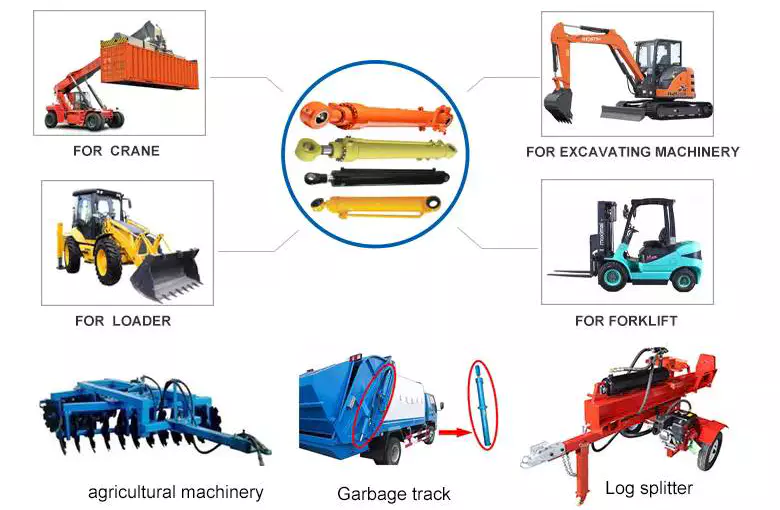
Which industries and machinery commonly use hydraulic cylinders for power transmission?
Hydraulic cylinders are widely used in various industries and machinery for power transmission due to their ability to generate high force, precise control, and reliable operation. They play a crucial role in converting hydraulic energy into mechanical force and motion. Here are the detailed industries and machinery that commonly utilize hydraulic cylinders for power transmission:
1. Construction and Heavy Equipment:
– Hydraulic cylinders are extensively used in the construction industry for tasks involving heavy lifting, pushing, and positioning. They are employed in cranes, excavators, loaders, bulldozers, and other heavy equipment to lift and move heavy loads, operate attachments, and manipulate construction materials. Hydraulic cylinders provide the necessary force and control for tasks such as lifting and lowering buckets, extending and retracting booms, and tilting blades.
2. Material Handling and Logistics:
– In material handling and logistics applications, hydraulic cylinders are vital components for the movement and manipulation of goods. They are used in forklifts, stackers, palletizers, and conveyor systems to lift, lower, and position loads with precision. Hydraulic cylinders enable the efficient transfer of heavy objects, facilitate stacking and sorting operations, and contribute to the smooth operation of material handling equipment.
3. Agriculture and Farming:
– The agricultural industry relies on hydraulic cylinders for various tasks in farming equipment. Tractors, harvesters, sprayers, and loaders utilize hydraulic cylinders to perform functions such as lifting and lowering implements, adjusting the position of attachments, and steering operations. Hydraulic cylinders enable efficient and precise control in tasks like plowing, tilling, harvesting, and baling, enhancing productivity and convenience in agricultural operations.
4. Mining and Extraction:
– Hydraulic cylinders are extensively utilized in the mining and extraction industry for their ability to handle heavy loads and operate in challenging environments. They are employed in mining equipment such as dump trucks, loaders, and excavators for tasks like ore extraction, rock breaking, and material transport. Hydraulic cylinders provide the force required for excavating, loading, and dumping operations, contributing to the efficiency and productivity of mining operations.
5. Manufacturing and Industrial Machinery:
– Hydraulic cylinders are an integral part of various manufacturing and industrial machinery. They are utilized in presses, stamping machines, injection molding machines, and metal forming equipment to apply force for shaping, bending, and pressing operations. Hydraulic cylinders enable precise control over the force and speed required for manufacturing processes, ensuring accurate and consistent results.
6. Automotive and Transportation:
– Hydraulic cylinders are employed in the automotive and transportation industry for a range of applications. They are used in vehicle lifting systems, such as car lifts and hydraulic jacks, for maintenance and repairs. Hydraulic cylinders are also utilized in bus doors, truck tailgates, and cargo handling systems to provide controlled movement and positioning. Additionally, hydraulic suspension systems in trucks, buses, and trailers use hydraulic cylinders for load leveling and stability.
7. Aerospace and Aviation:
– The aerospace and aviation industry relies on hydraulic cylinders for various applications, including aircraft landing gear, wing flaps, and flight control systems. Hydraulic cylinders provide the necessary force and precise control for extending and retracting landing gear, adjusting wing surfaces, and actuating control surfaces. They contribute to the safe and efficient operation of aircraft, ensuring reliable performance during takeoff, landing, and flight maneuvers.
8. Marine and Offshore:
– Hydraulic cylinders are utilized in marine and offshore equipment for a wide range of tasks. They are found in ship and boat steering systems, hatch covers, cranes, winches, and anchor handling equipment. Hydraulic cylinders enable precise control and powerful force transmission in maritime applications, supporting navigation, cargo handling, and offshore operations.
In summary, hydraulic cylinders are commonly used in industries such as construction, material handling, agriculture, mining, manufacturing, automotive, aerospace, marine, and more. They are integral components in machinery and equipment that require reliable power transmission, precise control, and the ability to handle heavy loads. The versatile nature of hydraulic cylinders allows them to be adapted to various applications, contributing to increased efficiency, productivity, and safety in numerous industries.


editor by CX 2023-11-01