Replacement identification works best when you turn the old actuator into a compact interchangeability drawing. Capture the machine interfaces first, then use labels or part numbers as supporting clues.
Build an Interchangeability Sketch
Draw the cylinder in its fully retracted condition and label the mounting centres, stroke, pin or bolt interfaces, rod end, barrel clearance and every hydraulic port. Mark the units beside each dimension so inch and metric values cannot be confused later.
Measure From Fixed Machine References
Where possible, confirm dimensions against the machine attachment points rather than relying on a damaged cylinder. A bent rod, worn eye or stretched clevis can distort measurements taken only from the removed part.
Document Mounts and Ports Separately
Record pin diameter, lug or clevis width, spherical-joint size, thread form, sealing style, port angle and hose clearance as separate fields. A cylinder can match stroke and closed length yet still be unusable because one of those interfaces differs.
Use Photos to Resolve Ambiguity
Photograph each end straight-on and from the side, then include the installed orientation if available. Put a ruler, thread gauge or caliper in the frame when scale is not obvious.
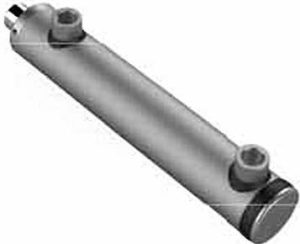
EP-KWA Series Metric Double-Acting Hydraulic Cylinder
EP-KWA metric double-acting cylinder series with bore, rod, stroke, outside diameter, length, port and weight data.
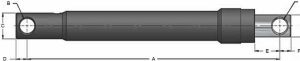
EP-SP Series Snow Plow & Utility Hydraulic Cylinder
EP-prefixed snow-plow replacement cylinder range with dimensional, port, temperature and weight data.
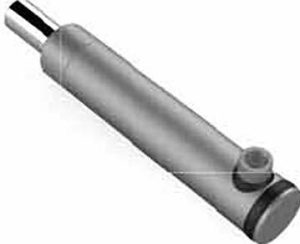
EP-KWI Series Metric Plunger Hydraulic Cylinder
EP-KWI metric plunger cylinder series with stroke, diameter, length, port and weight data.
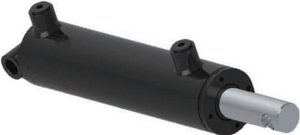
EP-WP Series 3000 PSI Welded Through-Hole Hydraulic Cylinder
EP-WP welded through-hole cylinder series with model dimensions, pressure, column-load and port data.
Frequently Asked Questions
Do I need both stroke and closed length?
Yes. Stroke defines travel while the retracted mounting length controls how the actuator fits the linkage.
Should I measure a damaged eye or clevis?
Use the machine interface or an undamaged reference when wear or bending could change the dimension.
How should I identify an unknown port?
Measure and photograph the thread and sealing surface; do not guess from appearance alone.
Is an OEM part number still useful?
Yes, but use it together with dimensions because revisions and previous substitutions can change the installed cylinder.
Which photo is most useful for cross-reference?
A set showing both mounts, ports, rod end and the cylinder installed in the machine is more useful than one overall photo.
Send a Replacement Measurement Set
Attach the sketch, photos and any machine or cylinder part number so the interfaces can be reviewed together.